Country Explorer
Explore how regional interests create opportunities for cooperation around the Red Sea.
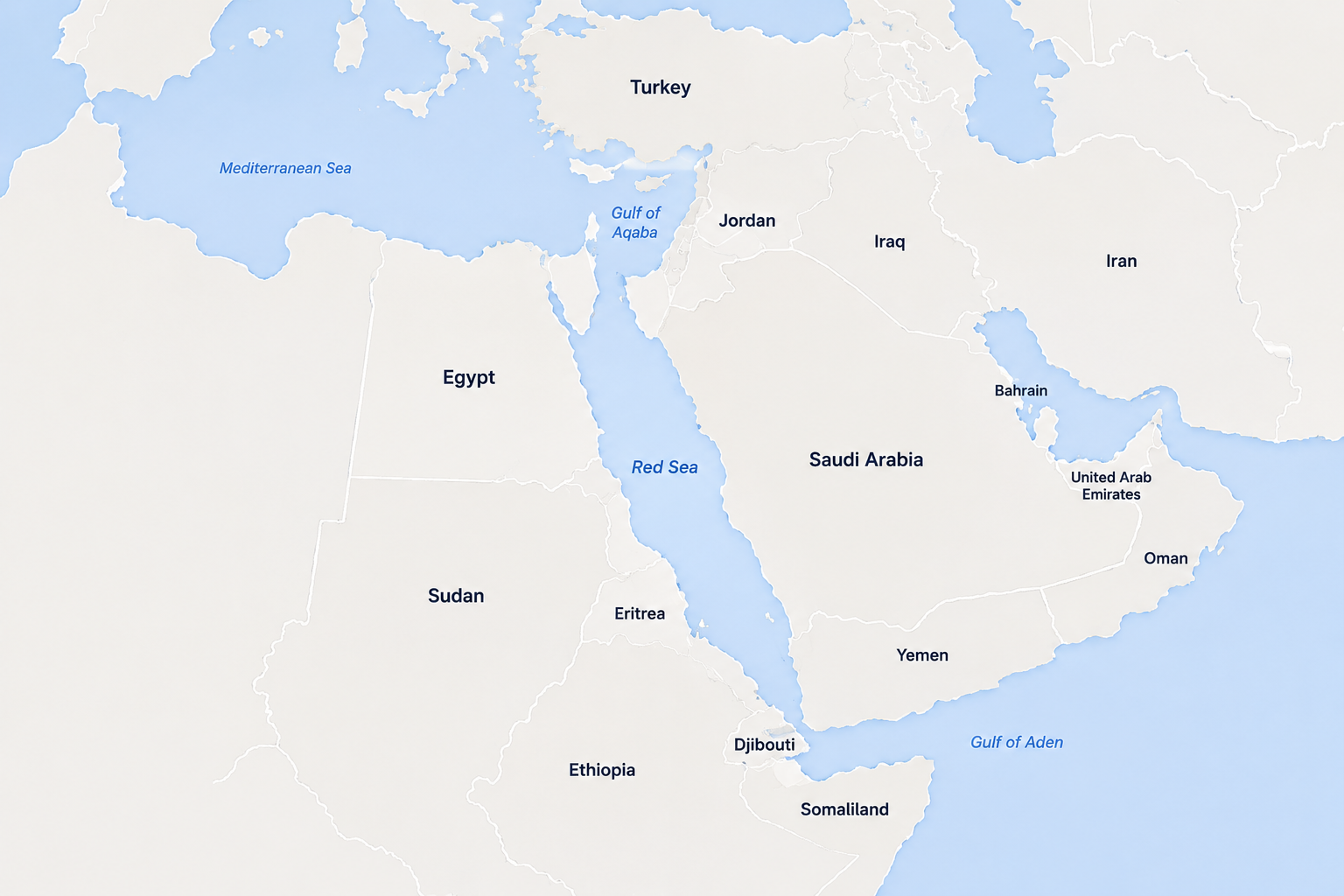
Click a country to jump to its profile below.
How to Read the Explorer
Each country views the Red Sea through a different lens. Some prioritize security, others economic development, tourism, infrastructure, or regional influence. Understanding these interests helps identify where cooperation is most likely to emerge.

Saudi Arabia
Strategic Takeaway
Saudi Arabia represents the most transformative long-term opportunity for regional integration: its Vision 2030 agenda, Red Sea tourism ambitions, and growing economic weight create multiple potential points of overlap with Israeli capabilities. Because normalization remains politically sensitive, that potential is most likely to be realized through gradual, low-visibility, sector-specific cooperation rather than visible diplomatic gestures.
What Matters
Saudi Arabia's regional outlook is shaped by Vision 2030, the kingdom's program to diversify its economy away from oil and position itself as a global hub for trade, tourism, and investment. The Red Sea coast is central to this vision, anchoring giga-projects and large-scale tourism development. Riyadh is also seeking to reduce its strategic dependence on the Strait of Hormuz by building out Red Sea-facing infrastructure, and it continues to see itself as the natural leader of any regional framework that emerges.
Cooperation Opportunities
Renewable energy corridors
Saudi solar and wind capacity along the Red Sea coast aligns with growing interest in cross-border electricity interconnection, creating a long-term opening for energy cooperation.
IMEC and trade connectivity
The India-Middle East-Europe Corridor depends on Gulf-to-Mediterranean land and sea links passing near or through the region, giving Saudi Arabia a direct stake in connective infrastructure that Israel could help support.
Red Sea tourism
As Saudi Arabia builds out resort destinations along its coast, shared interests in marine conservation, dive-tourism standards, and regional travel circuits create room for indirect cooperation.
Maritime security
Exposure to Houthi attacks and instability around the Bab el-Mandeb gives Saudi Arabia a direct interest in any arrangement that improves maritime security, even where it cannot be seen coordinating with Israel directly.
Environmental initiatives
Coral reef protection and marine research offer a politically low-risk entry point, since environmental cooperation can be framed in scientific rather than political terms.
Key Constraints
Public visibility of cooperation
Engagement that becomes publicly associated with Israel risks domestic and regional backlash, so cooperation must be structured to remain discreet or multilaterally framed.
Palestinian issue
Progress on normalization-adjacent cooperation is widely seen as contingent on movement on the Palestinian question, limiting how far Saudi Arabia can move independently of broader regional dynamics.
Religious symbolism
As custodian of Islam's holiest sites, Saudi Arabia is especially cautious about steps that could be portrayed as legitimizing Israeli positions on contested religious or territorial issues.
Competition with the UAE
Riyadh's desire to avoid ceding regional leadership to Abu Dhabi shapes the pace and framing of its own engagement, and may lead it to calibrate steps in response to what the UAE does.
Opportunity Profile

United Arab Emirates
Strategic Takeaway
The UAE is Israel's most advanced regional partner and the clearest example of functional cooperation becoming strategic partnership. Its logistics and investment networks already extend across the Red Sea and into the Horn of Africa, making it a natural anchor for expanding existing cooperation into new sectors and geographies rather than starting from scratch.
What Matters
The UAE has positioned itself as the region's logistics and investment hub, with state-linked companies operating ports and infrastructure across the Red Sea and Horn of Africa. Economic diversification, security guarantees against Iranian-aligned threats, and preserving its reputation as a stable, business-friendly center all shape how Abu Dhabi engages regionally. Because the UAE already has formal diplomatic relations with Israel, much of the relevant work is less about establishing a relationship than about expanding and deepening an existing one.
Cooperation Opportunities
Trade corridors
The UAE's port and logistics network already links the Gulf to the Horn of Africa and the Mediterranean, providing existing infrastructure that new trade routes involving Israel could plug into directly.
IMEC
As one of the corridor's key proponents, the UAE has a direct interest in the rail and shipping links IMEC would require, several of which would benefit from Israeli participation.
Port development
UAE-operated ports across Africa and the Gulf create openings for joint ventures or service agreements that extend existing commercial relationships into new locations.
Maritime security
Shared concern over Iranian-backed threats to shipping gives the UAE a strong incentive to support maritime security cooperation that includes Israel.
Horn of Africa investments
The UAE's existing footprint in Horn of Africa ports and infrastructure offers a ready-made platform for trilateral cooperation involving Israeli technology or expertise.
Key Constraints
Competition with Saudi Arabia
The UAE calibrates how visibly it cooperates with Israel partly based on its rivalry with Riyadh for regional economic leadership, which can introduce caution around high-profile initiatives.
Exposure to Iranian threats
The UAE's proximity to Iran and history of being targeted by Iranian-aligned actors means security cooperation, while valuable, also carries escalation risks that must be carefully managed.
Need to preserve its image as a stable investment hub
Abu Dhabi's brand as a neutral, business-friendly hub means it prefers cooperation that is commercially framed and does not draw it into regional disputes.
Opportunity Profile

Egypt
Strategic Takeaway
Egypt is already deeply connected to Israel through energy cooperation, giving it the most extensive functional relationship of any Arab littoral state. Cairo consistently prefers that this cooperation remain technical and below the political radar, so future expansion is more likely to happen through quiet, sector-specific channels than through public diplomatic initiatives.
What Matters
Egypt's regional priorities center on protecting Suez Canal revenues, securing reliable energy supplies, and maintaining its role as a leading voice in Red Sea governance and Arab regional diplomacy. As the most populous Arab state and a Red Sea littoral power, Cairo sees itself as entitled to a leading role in any regional framework, and is wary of arrangements that could be seen as bypassing Egyptian leadership or legitimizing a larger Israeli regional role than domestic public opinion can absorb.
Cooperation Opportunities
Natural gas cooperation
Egypt already imports Israeli natural gas and re-exports LNG, giving energy cooperation a proven track record that could expand further as regional demand grows.
Maritime security
Egypt's stake in Red Sea shipping security, heightened by Houthi attacks affecting Suez Canal traffic, creates a shared interest in stability even where direct coordination is politically sensitive.
Environmental protection
Coral reef and marine ecosystem protection in the Gulf of Aqaba and Red Sea offers a technical, low-visibility cooperation channel that avoids the political sensitivities of other issues.
Tourism
Red Sea tourism is economically significant for Egypt, and shared regional tourism circuits or safety standards could create indirect cooperation opportunities.
Research cooperation
Academic and scientific research partnerships, particularly on marine and environmental topics, provide a politically safe venue for sustained engagement.
Key Constraints
Public opinion
Egyptian public sentiment toward Israel remains largely negative, which limits the government's room to expand cooperation visibly without domestic political cost.
Palestinian issue
As a mediator on Gaza-related issues, Egypt's posture toward Israel is closely tied to developments in the Israeli-Palestinian conflict, and cooperation tends to contract during periods of escalation.
Reluctance toward visible cooperation
Cairo prefers that existing cooperation, such as gas exports, remain framed in commercial rather than strategic terms, to avoid the perception of a broader political alignment.
Preference for Arab-led regional frameworks
Egypt favors regional security and economic arrangements led by Arab states themselves, and is cautious about initiatives that appear to be designed or driven primarily by Israel or external powers.
Opportunity Profile

Jordan
Strategic Takeaway
Jordan offers some of the most practical near-term cooperation opportunities in the region, because many of its core needs, water, energy, and infrastructure, are technical rather than symbolic. The challenge is less about finding overlapping interests than about managing the domestic political sensitivities that surround any cooperation with Israel.
What Matters
Jordan's regional priorities are dominated by water scarcity, among the most acute in the world, alongside the need to create jobs and build economic resilience in a country with limited natural resources and a large refugee population. Infrastructure development, particularly around the Gulf of Aqaba, is central to its economic strategy. These needs are concrete and technical, which in principle makes them well suited to functional cooperation, but the government must balance this against a domestic public that is often more skeptical of normalization than the government itself.
Cooperation Opportunities
Water projects
Jordan's severe water scarcity creates a long-standing and growing need for desalination and water-sharing arrangements, an area where Israeli technology and experience are directly relevant.
Renewable energy
Solar power potential in Jordan's south, combined with regional electricity interconnection plans, creates room for energy cooperation that can be framed in technical and environmental terms.
Environmental cooperation
Joint environmental initiatives, particularly in the Gulf of Aqaba, offer a way to cooperate on shared ecological challenges without the political weight of broader normalization issues.
Gulf of Aqaba tourism
Jordan's tourism development around Aqaba could benefit from coordination on regional tourism circuits and shared marine resources with neighboring coastlines.
Key Constraints
Domestic political sensitivities
Jordanian public opinion is broadly critical of the relationship with Israel, particularly during periods of escalation in the Israeli-Palestinian conflict, which constrains how visibly the government can pursue cooperation.
Dependence on external financing
Many of Jordan's infrastructure and water projects depend on international donor financing, meaning cooperation often needs to fit within multilateral or donor-funded frameworks rather than bilateral arrangements alone.
Long-term reduction of dependence on Israeli water imports
Jordan has an underlying strategic interest in reducing reliance on Israel for water over time, meaning some forms of cooperation may be transitional rather than permanent.
Opportunity Profile
Somaliland
Strategic Takeaway
Somaliland's value lies primarily in geography: its position near the Bab el-Mandeb and its functioning port at Berbera make it relevant to Red Sea security and Horn of Africa trade routes, independent of the question of formal recognition. Cooperation here is likely to be shaped as much by other powers' involvement, particularly the UAE, as by direct bilateral dynamics.
What Matters
Somaliland's overriding priority is international recognition, which it has sought for decades without success. In the absence of recognition, it has focused on building economic and security relationships, particularly around the port of Berbera, which has attracted significant foreign investment. Its strategic location near one of the world's most important shipping chokepoints gives it relevance to maritime security discussions even though it remains unrecognized.
Cooperation Opportunities
Berbera Port
Berbera has already attracted major foreign investment and development, including from the UAE, creating an existing platform that further logistics or security cooperation could build on.
Maritime security
Somaliland's coastline sits close to the Bab el-Mandeb, making it relevant to any regional effort to monitor or respond to threats to Red Sea shipping.
Infrastructure
Ongoing port and road development around Berbera creates openings for technical or commercial involvement in projects already underway.
Logistics
As a node connecting the Horn of Africa to Gulf shipping routes, Somaliland's logistics sector offers opportunities that don't require navigating the recognition question directly.
Trade corridors
Berbera serves as an alternative trade route for landlocked Ethiopia, giving Somaliland a role in regional trade flows that extends beyond its own borders.
Key Constraints
Lack of broad international recognition
Somaliland's unrecognized status limits the kinds of formal agreements that are possible, meaning most engagement must occur through commercial or informal channels rather than state-to-state diplomacy.
Regional competition in the Horn of Africa
Somaliland sits within a crowded field of regional and international actors competing for influence in the Horn of Africa, so any engagement will be read in the context of those broader rivalries, particularly with Somalia and Ethiopia.
Opportunity Profile

Ethiopia
Strategic Takeaway
Ethiopia's development priorities, food security, water management, and trade access, create natural openings for practical, technically-focused cooperation. As Africa's second-most populous country and a major regional power, sustained engagement carries weight beyond the bilateral relationship itself, though its lack of a Red Sea coastline means it engages with the region primarily through trade and infrastructure rather than maritime issues.
What Matters
Ethiopia's regional outlook is shaped by the dual challenge of feeding a rapidly growing population and securing reliable trade access despite being landlocked. Agricultural productivity, water management, most visibly around the Grand Ethiopian Renaissance Dam, and connectivity to ports in Djibouti or Somaliland are central to its development strategy. Internal stability remains an ongoing concern that shapes how much bandwidth the government has for external engagement.
Cooperation Opportunities
Agriculture
Israeli expertise in arid-land agriculture and irrigation technology is directly relevant to Ethiopia's food security challenges, an area with a long history of technical cooperation.
Water management
Ethiopia's water management needs, particularly given regional tensions over the Nile, create demand for technology and expertise in efficient water use that Israel has developed domestically.
Technology
Broader technology transfer, particularly in agritech and water-related sectors, builds on existing cooperation and could expand as Ethiopia's economy develops.
Trade infrastructure
As a landlocked country dependent on neighboring ports, Ethiopia has a direct stake in the trade corridors and logistics infrastructure connecting it to the Red Sea coast, an area where regional cooperation could improve its access.
Key Constraints
Internal instability
Periods of internal conflict and political instability can limit the government's capacity to pursue or sustain external cooperation, and can make some forms of engagement reputationally complicated.
Limited maritime access
Because Ethiopia has no direct coastline, its interest in Red Sea cooperation is necessarily mediated through neighboring states' ports and infrastructure, adding a layer of dependency to any maritime-related initiative.
Opportunity Profile

Djibouti
Strategic Takeaway
Djibouti's importance is almost entirely a function of geography: its position at the Bab el-Mandeb and its role as a logistics hub for landlocked Ethiopia and for foreign militaries make it strategically significant well beyond its small size. Its dense concentration of foreign military bases also means any engagement takes place within a crowded field of great-power interests.
What Matters
Djibouti's economy is built almost entirely around its ports and its position at one of the world's busiest shipping chokepoints. Port revenues, much of it tied to serving Ethiopian trade, are the core of its economic model, and the country hosts military bases for several foreign powers that pay for access and use. Its strategic positioning, rather than its domestic resources, is its primary asset.
Cooperation Opportunities
Logistics
Djibouti's role as the primary trade gateway for Ethiopia gives it an established logistics sector that broader regional trade initiatives could plug into.
Shipping
Its location directly on the Bab el-Mandeb makes Djibouti relevant to any regional discussion of shipping safety and chokepoint security.
Maritime services
The presence of multiple foreign naval and military facilities means Djibouti already has experience hosting diverse international actors, which could lower the threshold for additional security-related cooperation.
Port connectivity
Continued investment in port capacity and connectivity to Ethiopia creates openings for involvement in infrastructure projects already underway.
Key Constraints
Competition from neighboring ports
Somaliland's Berbera port and other regional alternatives compete with Djibouti for Ethiopian trade traffic, giving Djibouti an incentive to maintain its position rather than open itself to arrangements that could benefit competitors.
Great-power competition around the Horn of Africa
With military bases belonging to the United States, China, France, and others already present, Djibouti's foreign policy is heavily shaped by balancing these relationships, leaving limited independent room for new initiatives.
Opportunity Profile

Bahrain
Strategic Takeaway
Bahrain is a willing and cooperative partner on regional integration generally, but its limited direct stake in Red Sea dynamics means it is more likely to play a supporting role, lending diplomatic and economic support to broader initiatives, than to be a primary driver of Red Sea-specific cooperation.
What Matters
Bahrain's foreign policy closely tracks broader Gulf trends toward regional stability and economic integration, and it was among the first Gulf states to establish formal relations with Israel. However, Bahrain's geography places it on the Gulf rather than the Red Sea, so the issues that dominate Red Sea diplomacy, shipping security and littoral-state coordination, are less directly relevant to its own interests than they are to Saudi Arabia, Egypt, or the UAE.
Cooperation Opportunities
Economic initiatives
As a smaller, diversified Gulf economy with established ties to Israel, Bahrain can participate in regional economic initiatives as a supportive partner even when it is not the primary geographic stakeholder.
Security coordination
Bahrain hosts significant U.S. naval presence and participates in regional security frameworks, giving it a role in broader maritime security coordination even without a direct Red Sea coastline.
Regional diplomacy
Bahrain's existing normalization with Israel allows it to act as a diplomatic supporter or convener for broader regional initiatives that include Israel.
Key Constraints
Regional political sensitivities
As with other Arab states with formal ties to Israel, Bahrain's government must weigh domestic and regional public opinion when considering how visibly to expand cooperation.
Limited direct Red Sea role
Because Bahrain is not a Red Sea littoral state, its interests in Red Sea-specific initiatives are largely indirect, making it unlikely to be a primary driver of Red Sea cooperation even where it is supportive.
Opportunity Profile

Turkey
Strategic Takeaway
Turkey is better understood as a competitor for influence in the Horn of Africa than as a cooperation partner within the Red Sea system. Its expanding military and economic presence in Somalia and elsewhere positions it as an actor whose moves Israel and regional partners need to track, rather than as a likely participant in joint initiatives.
What Matters
Turkey has pursued an active foreign policy of expanding its influence in the Horn of Africa, including a significant military and economic presence in Somalia, as part of a broader strategy of projecting power and securing economic interests across the region. Ankara's regional ambitions and its complex, often tense relationship with Israel mean that Turkish activity in the Red Sea region is generally viewed through a competitive rather than cooperative lens.
Cooperation Opportunities
Limited direct cooperation opportunities identified
Given the competitive dynamic between Turkish and Israeli regional interests, no significant cooperation opportunities with Turkey have been identified in this framework; Turkey is included primarily as a factor to monitor.
Key Constraints
Strategic competition with Israel and the UAE
Turkey's regional ambitions frequently put it in competition with both Israeli and UAE interests, particularly in the Horn of Africa, making cooperation politically difficult even where functional overlap might otherwise exist.
Expanding Turkish presence in Somalia and the Horn of Africa
Turkey's growing military and economic footprint in Somalia represents an expanding sphere of influence that could shape, and potentially complicate, other actors' room to maneuver in the region.
Opportunity Profile